Who Is Rahbar Ansari?
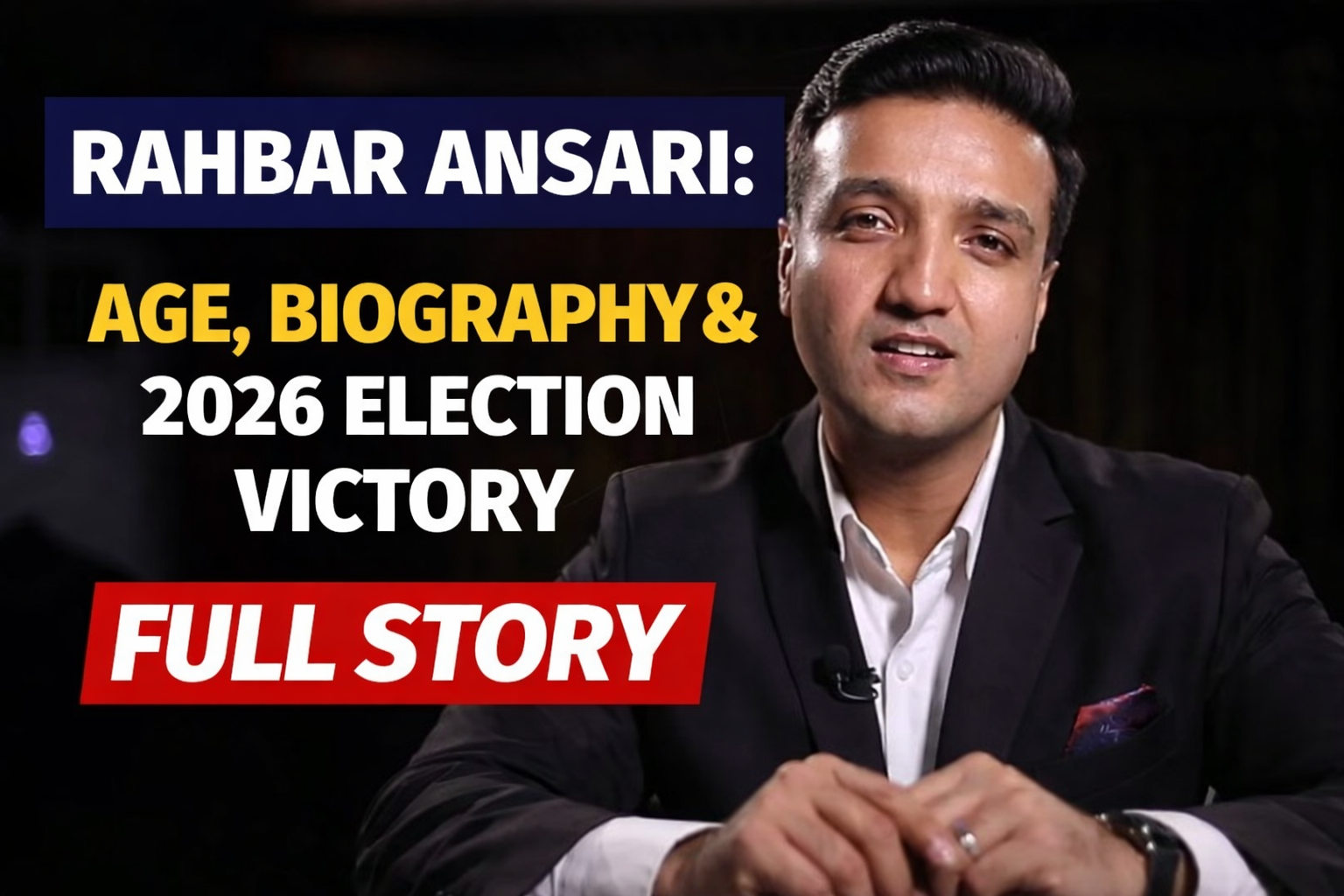
Rahbar Ansari is a Nepalese politician, currently 39 years old, serving as a Member of the House of Representatives from Bara Constituency No. 4, elected on the ticket of the Rastriya Swatantra Party (RSP) in the 2026 general election. He is one of the most striking political stories of the Madhesh Province — a young, outspoken lawmaker who has served in three different major political parties, held ministerial office, defied party whips, smeared soot on his own face on the floor of a provincial assembly, and then won a federal seat by a landslide of nearly 30,000 votes.
Based in Birgunj, the commercial hub of Nepal’s Madhesh Province bordering India, Ansari is widely described as a young and energetic politician with a reputation for independence and moral directness that has repeatedly put him at odds with party hierarchies — regardless of which party he happened to be in. He is an alumnus of Symbiosis Centre for Management Studies, Pune (SCMS-P), a TEDx speaker, and a participant in the U.S. Department of State’s prestigious International Visitor Leadership Program (IVLP). In 2025, he was honoured among Nepal’s “40 Under 40” influential young leaders — an award presented by the Prime Minister on International Youth Day.
His career arc — from Maoist Centre activist to provincial state minister to RSP federal MP — captures, in compressed form, the turbulent realignment of Nepal’s political landscape in the years following the 2015 constitution and the rise of new political forces across the country.
| Full Name | Rahbar Ansari |
| Age | 39 years old (born c. 1986, Kathmandu) |
| Father | Dr. Anwar Elahi Ansari |
| Base | Birgunj (Bahuri, Birgunj Maha Municipality), Madhesh Province, Nepal |
| Education | Symbiosis Centre for Management Studies, Pune (Batch 2004–07); Master’s Degree |
| Former Parties | CPN (Maoist Centre) → NCP → CPN-UML → RSP |
| Current Party | Rastriya Swatantra Party (RSP) |
| Provincial Role | Member, Madhesh Province Assembly (2022–2026); State Minister, Ministry of Industry, Forest & Tourism |
| Federal Role | Member, House of Representatives — Bara Constituency No. 4 (2026–present) |
| Election Result | 41,200 votes — margin of 29,561 over nearest rival |
| Notable Distinction | IVLP Alumnus (U.S. Dept. of State, 2019); TEDx Baneshwor Speaker; Nepal “40 Under 40” (2025) |
Early Life & Education
Rahbar Ansari was born in Kathmandu, around 1986, to his father Dr. Anwar Elahi Ansari. He grew up closely connected to the Madhesh region of Nepal — a Terai belt bordering the Indian states of Bihar and Uttar Pradesh, home to a large Maithili, Bhojpuri, and Urdu-speaking population. His family roots are in Birgunj, the bustling border city of Parsa district that serves as Nepal’s most important trade gateway with India, and he has spent the bulk of his political life based there.
For higher education, Ansari crossed the border in a different sense — he pursued a management degree at the Symbiosis Centre for Management Studies (SCMS), Pune, one of India’s respected private institutions under the Symbiosis International University umbrella. He completed his studies there between 2004 and 2007, graduating with a business management background that would inform his later approach to governance and public communication. He subsequently completed a Master’s Degree as well.
His alma mater later highlighted him as a distinguished alumnus after he delivered a talk at TEDx Baneshwor in Kathmandu, where he spoke on the vital role of youth participation in political leadership — a theme that has been the through-line of his entire public life. His educational background, combined with his Madhesh roots and multilingual fluency (he took his oath of office as State Minister in Bhojpuri), positioned him as an unusually cosmopolitan figure in Nepal’s Terai politics — much like how figures such as Rajesh Hamal bridged regional and national identities in Nepali public life.
In 2019, he was selected as a participant in the International Visitor Leadership Program (IVLP) — the U.S. Department of State’s flagship professional exchange programme — focusing specifically on Transparency and Accountability in Government. The IVLP is among the most selective leadership programmes available to emerging foreign public figures, and Ansari’s participation placed him in the company of future heads of state, ministers, and senior officials from across the world. In 2025, he was further recognised among Nepal’s “40 Under 40” influential young leaders, an award presented personally by the Prime Minister on International Youth Day.
Maoist Centre Years — Early Political Career
Rahbar Ansari’s formal political career began within the CPN (Maoist Centre) — the party founded by Pushpa Kamal Dahal ‘Prachanda’ that emerged from Nepal’s decade-long Maoist insurgency and transitioned into mainstream electoral politics after the 2006 Comprehensive Peace Accord. For a young man from Madhesh with strong views on representation, justice, and political courage, the Maoist Centre’s revolutionary rhetoric and emphasis on marginalized communities held natural appeal.
He rose to become an alternate central committee member of the Maoist Centre, a meaningful position of trust within a party that prizes ideological discipline. Despite his youth, he was recognised as a capable organiser and communicator in the Madhesh region — a part of Nepal where the Maoists, traditionally stronger in the hills, had struggled to build deep roots among Madhesi communities.
He contested elections multiple times before finally breaking through. He was defeated in the 2013 Constituent Assembly elections and again in local elections in 2017 and 2023 — setbacks that would have ended many political careers, but which Ansari weathered with characteristic persistence.
Defeated in 2013, 2017, and again in 2023 local elections — and yet each loss only sharpened his resolve. His eventual landslide in 2026 was years in the making.
— The Nepali Post, 2026Provincial Assembly Career — Madhesh Province (2022)
Despite repeated defeats at the ballot box, Ansari finally secured elected office through the 2022 general elections, winning a seat in the Madhesh Province Assembly from Parsa Constituency No. 1(A) — elected directly under the Maoist Centre banner as part of the ruling coalition’s arrangement in the province.
His entry into provincial legislature coincided with a period of intense political turbulence in Madhesh Province. The province, which covers Nepal’s central Terai, had cycled through multiple governments, coalition crises, and floor crossings in the years since Nepal’s federal system came into effect after the 2015 constitution. Ansari would soon find himself at the centre of several of those crises — sometimes as a stabilising voice, sometimes as the very source of the instability.
He was simultaneously listed as a central committee member of the Nepal Communist Party (NCP) — the short-lived merger entity that briefly brought several left parties together under Prachanda’s coordination — though this arrangement would not last.
State Minister — Ministry of Industry, Forest & Tourism
Ansari’s most prominent role in the Madhesh provincial government came when he was appointed State Minister in the Ministry of Industry, Forest and Tourism under Chief Minister Saroj Kumar Yadav’s coalition government. The appointment came as part of the Maoist Centre’s entry into the provincial cabinet — a coalition arrangement that completed the 15-member Madhesh government.
He took his oath of office in the Bhojpuri language — a deliberate and culturally significant choice in a province where Maithili, Bhojpuri, and Urdu are spoken alongside Nepali. The gesture was noted across Madhesh political circles as a statement of identity and regional pride. His co-oath-taker from the Maoist Centre, Minister Sunita Yadav, took her oath in Maithili — together, the two ministers represented the linguistic diversity of the Terai in a single ceremony.
As State Minister, Ansari was formally responsible for supporting the ministry’s work on industrial development, forest management, and tourism promotion in one of Nepal’s most economically significant provinces. The Madhesh region’s border economy, agricultural base, and emerging industrial zones gave the ministry real policy weight, and Ansari used the platform to raise his public profile across the region.
Dissent & Dramatic Protest — The Soot Incident
If one moment encapsulated Rahbar Ansari’s political character in the public imagination, it was an extraordinary scene on the floor of the Madhesh Province Assembly in August 2025. While Chief Minister Jitendra Sonal was presenting his motion for a vote of confidence, Ansari — then still a Maoist Centre lawmaker — smeared black soot across his own face in full view of the assembly.
It was not a random act. Ansari explicitly framed the protest as a response to what he described as the “growing immorality and unethical behavior of political parties and leaders” — a dramatic visual metaphor for the blackening of Nepal’s political culture. The image circulated widely on Nepali social media and news outlets, cementing his reputation as a politician willing to use unconventional means to make a principled point.
The soot protest was also a prelude to a more consequential act of defiance. When it came to the actual vote of confidence for Chief Minister Sonal, Ansari and fellow Maoist lawmaker Mala Karn publicly declared they would abstain — refusing to support their own party’s coalition position. Their abstention, combined with other defections, effectively doomed Sonal’s government, which collapsed just 25 days after its formation.
Smearing soot on his face on the floor of the Madhesh Assembly, Ansari turned a confidence vote into a moral statement — and the image went viral across Nepal.
— Khabarhub, August 2025The Maoist Centre, despite the open defiance of the party whip, chose not to take formal disciplinary action against Ansari or Karn — a decision that itself reflected the party’s weakening grip and declining internal authority in the Madhesh region.
Quitting the NCP — A Letter in Red
By early 2026, Rahbar Ansari had made up his mind. He formally resigned from the Nepali Communist Party (NCP) — the merger entity that had absorbed the Maoist Centre — sending his resignation letter to coordinator Pushpa Kamal Dahal ‘Prachanda’ by postal service. The manner of resignation was itself a statement: a formal letter, delivered through official channels, signed with a return address that symbolically treated Prachanda not as the current NCP chair but as the “former chairperson of the Maoist Centre.”
In the letter, Ansari invoked revolutionary slogans written in red letters — deliberately evoking the language of the Maoist insurgency to contrast it with what he saw as the current leadership’s abandonment of those ideals. His stated reason was unambiguous: “Since the party has abandoned courage, integrity and risk-taking, I can no longer be a part of such a contradiction.”
He also formally resigned from his position as a Madhesh Province Assembly member before filing his candidacy for the federal election — giving up his provincial seat to contest for a higher one, a gamble that spoke to his confidence in his own political standing in Bara.
Joining the Rastriya Swatantra Party
After leaving the NCP, Ansari did not join just any party. He chose the Rastriya Swatantra Party (RSP) — the newest and most disruptive force in Nepalese politics, founded by former journalist and Kathmandu Mayor Balen Shah and associated with Nepal’s youth-driven reform wave. The RSP had emerged as the voice of anti-establishment sentiment, drawing young, educated, urban voters frustrated with the recycled politics of the older left and centrist parties.
Ansari formally joined RSP at the party’s “Declaration of Change” event held in Janakpur — a symbolically loaded location, as Janakpur is the cultural and religious capital of Madhesh and the heart of Maithili-speaking Nepal. By joining RSP on the Madhesh stage, Ansari was positioning himself — and RSP — as part of a new political conversation in the Terai, not just in Kathmandu’s urban core.
His profile fitted RSP’s emerging identity: educated, outspoken, independent-minded, and willing to challenge party orthodoxy. His history of defying whips and resigning over principle, rather than for personal gain, gave him credibility as a genuine RSP convert rather than an opportunistic switcher.
Joining RSP at Janakpur’s “Declaration of Change” event, Ansari signalled that the RSP wave was not just a Kathmandu phenomenon — it had arrived in the Madhesh heartland.
— Khabarhub / Threads, 2026The 2026 Election — Landslide in Bara-4
When the House of Representatives by-election was announced following Nepal’s Gen Z-driven political upheaval of late 2025 — which forced early elections across the country — Rahbar Ansari filed his candidacy from Bara Constituency No. 4 under the RSP banner. It was his first federal election as an RSP candidate, and his first time contesting in Bara rather than Parsa.
The result was not close. Ansari won 41,200 votes — his nearest rival, Krishna Kumar Shrestha (Kisan) of the CPN-UML, received just 11,639 votes. The margin of victory was 29,561 votes — a crushing, unambiguous mandate in a constituency that had not previously been considered RSP stronghold territory.
Sanju Sah Kanu of the Janata Samajwadi Party (JSP) Nepal finished a distant third with 7,593 votes. Also defeated were Sarbendra Khanal (former Inspector General of Police and chairman of Samunnat Nepal Party) and Samim Miya Ansari, former head of the Nepal Muslim Commission — the scale of the RSP wave sweeping out not just ordinary opponents but former security chiefs and senior community leaders.
| Candidate | Party | Votes | Result |
|---|---|---|---|
| Rahbar Ansari | Rastriya Swatantra Party (RSP) | 41,200 | Winner 🏆 |
| Krishna Kumar Shrestha (Kisan) | CPN-UML | 11,639 | 2nd Place |
| Sanju Sah Kanu | Janata Samajwadi Party (JSP) Nepal | 7,593 | 3rd Place |
| Sarbendra Khanal | Samunnat Nepal Party | — | Defeated |
| Samim Miya Ansari | Independent / other | — | Defeated |
Ansari’s victory was notable for yet another reason: he was one of four Madhesh Province Assembly members who had resigned their provincial seats to contest the federal election. Of those four, only Ansari won — the other three suffered heavy defeats. He had given up his guaranteed provincial position to take the gamble, and the gamble paid off spectacularly.
RSP’s Madhesh Wave — The Bigger Picture
Rahbar Ansari’s victory in Bara-4 was not an isolated result. It was part of a historic RSP sweep across Madhesh Province that reshaped the political map of Nepal’s Terai belt. In the 2026 elections, RSP candidates were elected in 30 out of 32 constituencies in Madhesh Province — a near-total dominance of a region that had long been shared between the Janata Samajwadi parties, CPN-UML, and the Nepali Congress.
The scale of the RSP breakthrough in Madhesh was arguably as significant as its more-publicised victories in Kathmandu. It demonstrated that the party’s appeal had crossed the hills-Terai divide that has historically structured Nepalese politics — and that Ansari, as one of the first prominent Madhesi figures to join RSP, had played a role in building that credibility. For more on the party’s origins and leadership, see our full profile of Balen Shah, the RSP founder who became Prime Minister-designate following the 2026 landslide.
RSP also won in Bara-3 and was leading in Bara-1 and Bara-2 on election night — making Bara one of the party’s strongest districts in the country. The pattern suggested that Ansari’s personal vote, while real, was amplified by a broader wave that RSP had built through its anti-corruption, youth-focused, and federalism-supporting platform.
For Ansari personally, the federal win represented the completion of a long journey — from activist to provincial lawmaker to State Minister to federal MP, via multiple party memberships, electoral defeats, acts of conscience, and finally, a landslide that left little room for debate about his standing in Madhesh politics.
2 thoughts on “Rahbar Ansari: Age, Biography & 2026 Election Victory | FameReports”
Comments are closed.