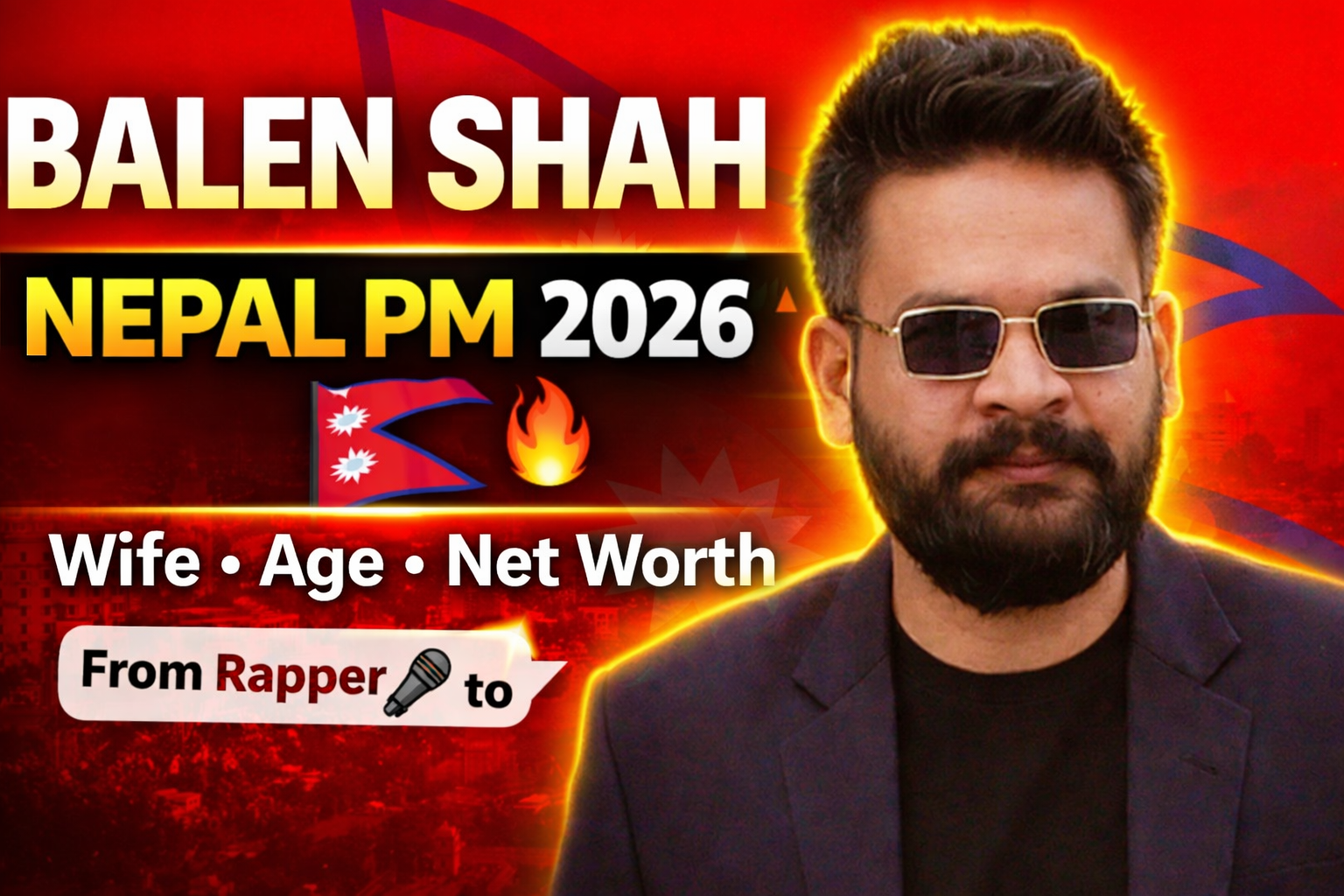
From rap battles in Kathmandu’s underground to demolishing corruption with a bulldozer — the complete story of how a structural engineer became Nepal’s most powerful political force.
Balen Shah — full name Balendra Shah, born April 27, 1990, in Naradevi, Kathmandu — is Nepal’s 40th Prime Minister, sworn in on March 27, 2026. A structural engineer by training, a rapper by passion, and a bulldozing reformer by instinct, he became the first independent candidate ever elected Mayor of Kathmandu in 2022. In March 2026, he led the Rastriya Swatantra Party (RSP) to a historic landslide — winning 182 of 275 seats in parliament — and was appointed Prime Minister by President Ram Chandra Paudel, becoming Nepal’s youngest Prime Minister and its first of Madheshi origin. This is his complete biography, fully updated March 28, 2026.
Early Life & Family Background
Balendra Shah was born on April 27, 1990, in the Naradevi neighbourhood of Kathmandu, Nepal. He is the youngest of four siblings in a Madheshi (Maithili-speaking) family that originally hailed from Ekdara, Mahottari District in Nepal’s Madhesh Province. His parents relocated to the capital after his father, Ram Narayan Shah, was posted to the Naradevi Ayurvedic Hospital as an Ayurvedic practitioner.
Growing up in Naradevi, one of Kathmandu’s historically dense and culturally rich neighbourhoods, Balen was immersed from an early age in the city’s complicated mix of tradition and neglect — potholed roads, open sewers, traffic chaos, and political apathy. Those early experiences would fuel both his rap lyrics and his mayoral agenda decades later.
His father, Dr. Ram Narayan Shah, was a deeply respected figure in Ayurvedic medicine, eventually rising to serve as Managing Director of the Singha Durbar Baidyakhana. He passed away in December 2025, just weeks before his son’s formal entry into national politics — a loss Balen acknowledged publicly and with characteristic emotional directness. His mother, Dhruvadevi Shah, is a homemaker who remains a steady presence in his life.
Balen identifies proudly with his Madheshi heritage. He speaks Maithili fluently alongside Nepali, and follows Buddhism. His ancestral home remains in Mahottari, even as he has spent his entire life in Kathmandu. That dual identity — capital-city cosmopolitan with rural Madhesh roots — has become central to his political story and his claim to represent Nepal’s long-marginalised Madheshi communities.
Education
Balen Shah completed his SLC (School Leaving Certificate) from Alliance Academy in Kathmandu. He then attended VS Niketan Higher Secondary School for his 10+2, where he excelled in science and mathematics — establishing an academic foundation that would later distinguish him from Nepal’s typically career-politician leadership class.
He pursued a Bachelor’s degree in Civil Engineering from Himalayan WhiteHouse International College, affiliated with Purbanchal University. His academic aptitude earned him admission to Visvesvaraya Technological University (VTU) in Karnataka, India, where he completed a Master’s degree (MTech) in Structural Engineering.
In a further sign of intellectual ambition, Shah has been pursuing a PhD in traditional infrastructure at Kathmandu University, blending his technical expertise with Nepal’s architectural heritage. His engineering credentials — rare among Nepali politicians — give him the technical authority to speak concretely about Kathmandu’s crumbling infrastructure, and are part of why voters trusted him where they had long ceased to trust career politicians.
| SLC | Alliance Academy, Kathmandu |
| 10+2 | VS Niketan Higher Secondary School |
| Bachelor’s (BE) | Civil Engineering — Himalayan WhiteHouse International College |
| Master’s (MTech) | Structural Engineering — Visvesvaraya Technological University, India |
| PhD (ongoing) | Traditional Infrastructure — Kathmandu University |
Rapper & Music Career — From Sadak Balak to Stardom
Before politics, before engineering, Balen Shah was a rapper. His first song, “Sadak Balak” (Street Kid), was written when he was still in the ninth grade — a raw, socially conscious track about urban youth struggling in a city that had forgotten them. It was a preview of the voice he would eventually bring to the mayor’s office.
His breakthrough came in 2013 when he participated in the second season of Raw Barz, Nepal’s premier Nepali-language rap battle league. He won the season finale, defeating Litl Grizl with 13 rebuttals and multilayered rhymes, and virtually overnight became a household name among Nepali youth. His style was sharp, his content political, and his delivery uncompromising — qualities that made him simultaneously beloved by young fans and uncomfortable for the establishment.
His catalogue grew to include fan favourites such as “Hami Yestai Ta Ho Ni Bro” (2019), “Local Thito,” “Gaita Badhyo,” “Temi Phool,” “Marpha ko Madhira,” and “Man Yo Udyog” — songs that addressed corruption, inequality, youth unemployment, and the failures of Nepal’s political system. According to Encyclopædia Britannica, his music videos frequently featured Kathmandu’s streets, traditional chowks, and public spaces, deepening his bond with the city he would later govern.
In 2025, even as Mayor, Shah released “Nepal Haseko…” — a track he wrote, composed, and performed for the Nepali film Laaj Sharanam. It entered the YouTube trending music charts following its release, proving his musical appeal had not diminished even as his political star rose.
He also served as a judge on the Nepali rap competition show “Nephop ko Shreepech,” cementing his status as an elder statesman of Nepal’s hip-hop scene even while serving as its capital’s mayor.
His songs were highly popular among young protesters. He used rap as political expression long before he entered politics — and it never stopped being political.
— Narayan Kadariya, political campaigner, quoted in Kathmandu PostMayor of Kathmandu (2022–2026) — The Independent Who Won
Balen Shah had been quietly planning a mayoral run since 2020. On December 17, 2021, he announced his candidacy on Facebook — standing as a completely independent candidate, with no party backing, no political machinery, and no family dynasty behind him. His campaign symbol was a walking stick (lauro) — a deliberate rejection of the party flags and symbols that had dominated Nepali politics for decades.
The establishment dismissed him. His opponents were formidable: Srijana Singh of the Nepali Congress and Keshav Sthapit, the former mayor and CPN-UML’s candidate. Both had deep networks, party resources, and institutional support. Balen had social media, a tight-knit volunteer team, and an electorate that had simply stopped believing the old parties would ever fix Kathmandu.
In the May 2022 local elections, Shah won decisively. He secured 61,767 votes — comfortably ahead of Singh’s 38,341 and Sthapit’s 38,117. The result sent shockwaves through Nepal’s political establishment. He became the 15th Mayor of Kathmandu and the first independent candidate ever to hold the office.
He was sworn in carrying the same walking stick he had campaigned with, wearing simple attire, surrounded by volunteers rather than party officials. It was a visual statement as much as a political one.
Mayoral Achievements — What Balen Actually Built
Four years in office produced a mixed but genuinely distinctive record. Balen’s administration undertook reforms that previous mayors had avoided, ignored, or profited from reversing.
| Area | Initiative | Impact |
|---|---|---|
| Governance | Live broadcasting of KMC council meetings | Transparency ✓ |
| Digital Services | Digital building permits system | Efficiency ✓ |
| Waste Management | Labour Bank cleaners for temples & rivers | Urban reform ✓ |
| Infrastructure | Road maintenance & footpath upgrades | Visible ✓ |
| Enforcement | Demolition of thousands of illegal structures | Controversial ⚠ |
| Culture | Cultural heritage preservation investment | Celebrated ✓ |
| Accountability | Investigation into contractor corruption (Guragain case) | Disputed ⚠ |
His administration was recognised internationally: TIME Magazine named him to the TIME 100 Next list in 2023, describing him as one of the world’s most influential emerging leaders. In 2025, he was awarded the Mayor of the Year title by Democracy Local, an international local governance organisation, for his efforts in transparent and accountable city management.
Controversies — The Other Side of the Bulldozer
Balen Shah’s tenure was never without controversy. His administration’s aggressive enforcement policies — particularly the demolition of illegally constructed structures — affected thousands of residents, including many from vulnerable communities. Critics argued that demolitions were conducted without adequate rehabilitation plans, displacing squatter settlements and street vendors who depended on those locations for their livelihoods.
His relationship with the federal government was openly adversarial. A prolonged dispute with Prime Minister KP Sharma Oli over the appointment of a Chief Administrative Officer resulted in administrative paralysis at KMC, leaving over 3,500 employees — including teachers — without salaries for months. Oli publicly called Balen “a reckless boy” in March 2024. Balen responded with characteristic combativeness.
In September 2023, following an incident where his wife Sabina Kafle was stopped by traffic police, Shah posted a threat to “set Singha Durbar on fire” on Facebook. The post was deleted within 30 minutes but not before it had drawn 34,000 reactions. Civil society broadly condemned the statement, though his supporters argued it reflected justified frustration. It exemplified both his unfiltered authenticity and its risks.
Multiple controversies during Balen’s mayoral tenure reflect the challenges of independent governance in Nepal’s deeply entrenched political system, where federal and local governments are frequently in conflict. His record should be read in that context — as should his supporters’ contention that much of the criticism came from political interests threatened by reform.
The 2025 Gen Z Protests — Nepal’s Political Earthquake
In September 2025, Nepal erupted. Mass protests, led by young people and quickly dubbed the “Gen Z movement,” swept Kathmandu and other cities in response to the government of Prime Minister KP Sharma Oli — targeting corruption, the government’s crackdown on digital freedoms, and the broader failures of Nepal’s political establishment. According to Al Jazeera’s reporting, the protests resulted in the death of 77 people, the resignation of Oli, and the installation of a caretaker government led by former Chief Justice Sushila Karki.
Balen Shah was a high-profile backer of the protesters. His social media presence amplified their message, and his identity as an outsider who had already beaten the system in 2022 made him a natural figurehead. Gen Z activists widely named him as their first choice for interim Prime Minister.
He declined. Instead, he supported Karki for the interim role — a decision that analysts described as politically masterly. By stepping back from a six-month transitional stint, he preserved his credibility and set himself up for a full five-year term as elected Prime Minister.
He traded a six-month temporary stint for a shot at a full five-year term as Prime Minister. It was a masterstroke of foresight.
— NewKerala Political Analysis, January 2026On December 28, 2025, Shah formally unified with the Rastriya Swatantra Party (RSP). He resigned as Mayor of Kathmandu on January 18, 2026, and launched his national election campaign from Janakpur the following day — choosing to contest in the heart of Madhesh, his ancestral region, but also in Jhapa-5, the long-standing stronghold of KP Sharma Oli.
2026 General Election — Defeating Oli by a Record Margin
The March 5, 2026 Nepalese general election produced results that would have seemed impossible just four years earlier. The RSP, energised by Shah’s entry and the momentum of the Gen Z movement, emerged as the dominant force in early vote counts, leading in over 90 of 165 directly elected seats. The party swept all ten constituencies of the Kathmandu Valley.
In Jhapa-5 — Oli’s own stronghold, 300km from Kathmandu — Shah won with 68,348 votes to Oli’s 18,734: a winning margin of 49,614 votes. As confirmed by the Election Commission of Nepal, this was the highest individual vote total ever recorded in Nepal’s parliamentary election history, surpassing the previous record of 57,139 votes — also set by Oli himself in the same constituency in 2017.
Shah was officially elected to the House of Representatives from Jhapa-5 on March 7, 2026, receiving his victory certificate the same day. He became Nepal’s Prime Minister-designate and was sworn in as the country’s 40th — and youngest — Prime Minister on March 27, 2026. He is also the first Madheshi-origin Prime Minister in Nepal’s history.
Prime Minister of Nepal — Sworn In March 27, 2026
On March 27, 2026, Balendra Shah was sworn in as Nepal’s 40th Prime Minister at a special ceremony at the Office of the President, Shital Niwas, Kathmandu. President Ram Chandra Paudel administered the oath of office and secrecy under Article 76(1) of Nepal’s Constitution. The swearing-in took place at 12:34 pm on Ram Navami — a timing selected by Hindu priests as astrologically auspicious, fitting the symbolic “1-2-3-4” numerological pattern.
Shah arrived wearing black trousers, a matching jacket, his signature black Nepali cloth cap, and sunglasses — the same understated, identity-consistent look he has worn throughout his public career. Army bands played, diplomats queued to congratulate him, and hundreds of supporters cheered outside the presidential residence. Euronews reported that Modi congratulated Shah on X: “Your appointment reflects the trust reposed in your leadership by the people of Nepal.” China’s Foreign Ministry also issued a formal congratulations.
Before the swearing-in, Shah released a new rap song — in keeping with his identity — titled as a message of national unity. It was widely shared across Nepal’s social media the same day he took office.
Balen Shah’s Cabinet — Nepal’s Youngest-Ever Government
Shah announced his Cabinet immediately following his appointment, retaining the Defence and Industry portfolios himself. Key appointments include:
| Minister | Portfolio | Note |
|---|---|---|
| Balen Shah | Prime Minister + Defence + Industry | Age 35 |
| Swarnim Wagle | Deputy PM + Finance Minister | Age 51 — oldest in cabinet |
| Sudan Gurung | Home Minister | Gen Z protest organiser, Hami Nepal founder |
| 10 of 15 ministers | Various portfolios | Under 40 years old |
As The Himalayan Times confirmed, 10 of the 15 cabinet members are under 40 — making this Nepal’s youngest-ever government and a direct fulfilment of the Gen Z protest movement’s demand for generational change in leadership. The appointment of Sudan Gurung — founder of Hami Nepal and the principal organiser of the 2025 youth protests — as Home Minister is particularly significant, placing the architect of the movement that made this government possible in charge of Nepal’s internal security apparatus.
Wife: Sabina Kafle — The Woman Behind the Movement
Balen Shah’s wife is Sabina Kafle, a public health professional and published author who has become one of the most quietly admired figures in Nepal’s political landscape. Their love story has a distinctly modern beginning: Sabina connected with Balen through her poems, which she had been sharing online. He was drawn to her writing before they ever met in person — a beginning that has made them one of Nepal’s most beloved couples.
| Full Name | Sabina Kafle Shah |
| Profession | Public Health Professional, Author |
| Employer | UNFPA Nepal |
| Education | Bachelor’s in Public Health — Kathmandu University |
| Published Work | Novel: Deepalta |
| Married | Balen Shah, 2018 |
| Children | One daughter (born September 2023) |
| Residence | Gairigaun, Tinkune, Kathmandu |
Sabina Kafle holds a Bachelor’s degree in Public Health from Kathmandu University and works with UNFPA Nepal (United Nations Population Fund) — a career that reflects her own independent professional identity entirely distinct from her husband’s fame. She is also a published novelist; her book Deepalta has earned her recognition as a writer in her own right.
The couple married in 2018 and welcomed their first child, a daughter, in September 2023. The birth was surrounded by a controversy of its own — Balen sparked a national furore by threatening to burn down Singha Durbar after Sabina was stopped by traffic police while travelling in a KMC vehicle. His personal advisor later revealed she had been travelling to hospital, though the timeline of the incident was disputed. The episode, while controversial, revealed both the depth of Balen’s protectiveness of his family and the scrutiny that public life brings.
Sabina is known for maintaining a private public profile even as her husband occupies the most-watched political position in Nepal. She appears occasionally in Balen’s social media posts and during major political moments, providing a grounded counterpoint to his combative public persona.
Balen Shah Net Worth — Earnings, Engineering & Politics
Balen Shah’s financial profile is modest by the standards of Nepal’s political class — which is itself part of his appeal. His estimated net worth is NPR 5–6 crore (approximately USD 370,000–450,000), accumulated from three primary sources:
Engineering Consultancy
The bulk of his private income comes from Balen Consulting & Construction Pvt. Ltd., where he serves as Managing Director. As a qualified structural engineer with a master’s degree from an Indian university, his firm has been involved in infrastructure and construction projects in Nepal.
Music Career
While rap is unlikely to generate substantial income in Nepal’s market, Balen’s music catalogue, YouTube presence, and occasional television appearances (including as a judge on Nephop ko Shreepech) contribute supplementary earnings.
Mayoral & Political Salary
His official mayoral salary was approximately NPR 46,000 per month (roughly USD 340). Combined income across all streams is estimated at approximately NPR 3 lakh per month (~USD 2,250). As Prime Minister, his official salary will be governed by Nepal’s government pay structures.
Balen’s publicly declared asset disclosures, as required of all mayoral candidates under Nepal’s Election Commission regulations, confirmed a relatively modest personal wealth — a contrast with many established politicians who declare implausibly low assets despite extensive property holdings. This transparency, while not proof of poverty, has reinforced his anti-corruption positioning.
Awards & International Recognition
| Year | Award | Awarded By |
|---|---|---|
| 2023 | TIME 100 Next — World’s Most Influential Emerging Leaders | TIME Magazine |
| 2025 | Mayor of the Year | Democracy Local |
| 2026 | 40th Prime Minister of Nepal — Sworn In March 27, 2026 | Appointed by President Ram Chandra Paudel |
| 2026 | Record Parliamentary Vote Total (68,348) | Election Commission of Nepal |
His TIME 100 Next recognition in 2023 brought him international attention that went far beyond Nepal, framing his story as part of a global phenomenon of young, outsider politicians challenging entrenched systems. It was also a legitimising moment — confirmation that his impact was visible and credible beyond the Bagmati Valley. For a broader profile of his political arc, Encyclopædia Britannica’s biography of Balen Shah provides useful additional context.
7 thoughts on “Balen Shah Biography: Wife, Age, Net Worth & Nepal Prime Minister 2026”
Comments are closed.