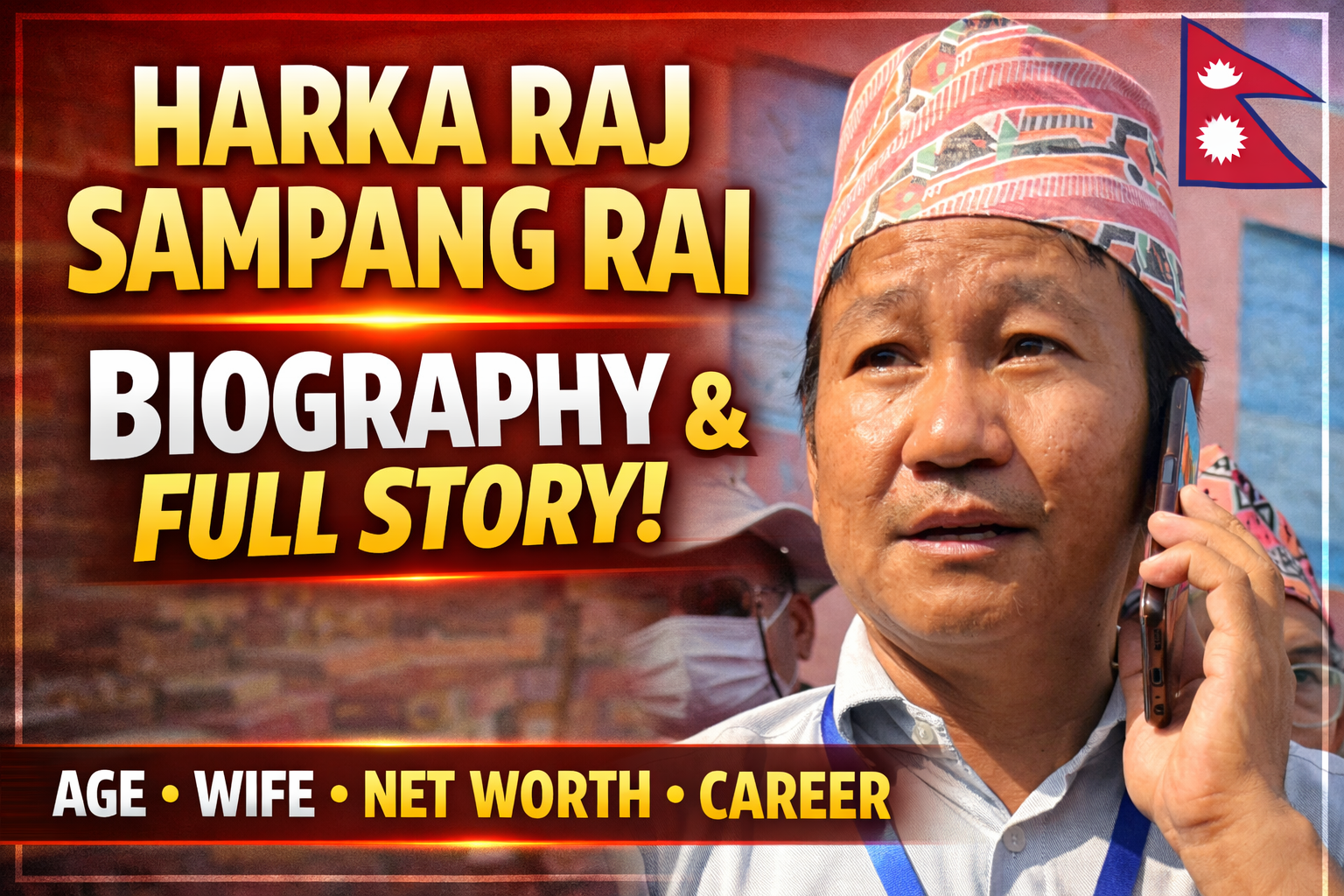
Who Is Harka Raj Sampang Rai?
Harka Raj Sampang Rai — popularly known as Harka Sampang (Nepali: हर्कराज साम्पाङ राई) — is a Nepali politician, social activist, former Mayor of Dharan Sub-Metropolitan City, and Member of Parliament for Sunsari-1 elected in the March 2026 general election. Born on February 27, 1983, in Khartamchha, Khotang District, Nepal, he rose from a modest rural background — his father a British Gurkha soldier — through years of struggle abroad, grassroots activism, and a once-abandoned dream of becoming a singer, to become one of Nepal’s most distinctive and disruptive political voices.
He was the first independent candidate ever elected Mayor of Dharan in the May 2022 local elections, winning with 20,821 votes against entrenched Nepali Congress and CPN-UML candidates. His tenure was defined by the “Shramdaan” movement — a philosophy of hands-on community labor — and high-profile projects including a volunteer-built 42km water pipeline. In November 2025, he founded the Shram Sanskriti Party (SSP), whose ideology, known as “Harkabad,” centres on labor culture, environmental stewardship, and political reform. His signature battle cry — Jai Maato! Jai Desh! — translates as “Victory to the Soil! Victory to the Nation!”
| Full Name | Harka Raj Sampang Rai (हर्कराज साम्पाङ राई) |
| Known As | Harka Sampang |
| Date of Birth | February 27, 1983 |
| Age (2026) | 43 years old |
| Birthplace | Khartamchha, Khotang District (now Kepilasgadhi Rural Municipality), Nepal |
| Ethnicity | Rai (Kirat community) |
| Height | 5 ft 3 in (160 cm) |
| Religion | Kirat (Mundhum) |
| Father | Til Bikram Rai (British Gurkha soldier) |
| Wife | Nirmala Limbu |
| Education | MA Political Science — Tribhuvan University |
| Early Career | Teacher, auto-rickshaw driver, migrant worker |
| Occupation | Politician, Social Activist |
| Party | Shram Sanskriti Party (founder & chairman) |
| Election Symbol | Walking Stick (Lauro) — 2022 local; Shram Sanskriti Party — 2026 national |
| Mayor of Dharan | May 23, 2022 – January 19, 2026 |
| MP (2026) | Sunsari-1, House of Representatives |
| Battle Cry | Jai Maato, Jai Desh! (Victory to the Soil, Victory to the Nation!) |
| Hobbies | Singing, Dancing, Travelling |
Early Life & Family Background
Born on February 27, 1983, in Khartamchha, Khotang District — a remote hilly village in eastern Nepal, now part of Kepilasgadhi Rural Municipality — Harka Raj Sampang Rai grew up in modest, traditional circumstances. He is the son of Til Bikram Rai, a former soldier in the British Gurkha. Growing up in a Gurkha family meant discipline and resilience were instilled early — values that would later shape both his activism and his style of governance.
His ancestral roots are in the Rai (Kirant) community of eastern Nepal — one of the indigenous peoples of the Himalayan foothills with a rich culture of warrior tradition, nature worship under the Mundhum philosophy, and deep connection to the land. That connection to soil, labour, and community would become the literal foundation of his political ideology decades later.
After completing his School Leaving Certificate (SLC) examinations, Rai moved to Dharan in 1998 (2057 BS) to pursue higher education. Despite the Gurkha family background, his life was marked not by comfort but by struggle. Dharan — a vibrant city in Sunsari District — was a natural destination for ambitious young people from the eastern hills, with its colleges, economic activity, and large Rai and Limbu community presence.
Education
Harka Sampang completed his school-level education in Khotang before relocating to Dharan. He earned a Bachelor of Arts degree in English and Political Science from Mahendra Multiple Campus in Dharan. He went on to complete a Master’s degree in Political Science from Tribhuvan University — Nepal’s largest and oldest university — giving him a formal academic grounding in governance and political theory that distinguishes him from many self-styled populist politicians.
His early career after graduation was as a tutor (teacher), reflecting both his educational background and a practical need to support himself in Dharan. That teaching experience — explaining ideas clearly to ordinary people — arguably contributed to his later effectiveness as a communicator and social mobiliser.
| School Level (SLC) | Khotang District, Nepal |
| Moved to Dharan | 1998 (for higher education) |
| Bachelor of Arts | English & Political Science — Mahendra Multiple Campus, Dharan |
| Master’s Degree | Political Science — Tribhuvan University, Nepal |
| Post-graduation | English tutor; later auto-rickshaw driver and businessman |
Life Abroad — Iraq, Afghanistan & the Gulf
Like hundreds of thousands of young Nepali men, Harka Sampang sought economic opportunity outside Nepal. He worked abroad in Iraq and Afghanistan, as well as Gulf countries — a period of approximately six years in total — doing manual labour in conditions that most of his future voters would intimately recognise.
This experience was formative in ways that go beyond the financial. Working abroad in conflict-adjacent zones and labour-exploitative conditions gave Sampang a direct, visceral understanding of what Nepal’s failure to provide economic opportunity at home costs its citizens. It also gave him the credibility, when he later spoke about labour dignity and economic reform, to do so as someone who had lived those realities — not merely theorised about them.
When Harka Sampang used to drive tempos on the streets of Dharan or sweat in the scorching deserts of the Gulf, he probably never imagined that one day he would shake the very foundation of Nepal’s parliamentary politics.
— Ratopati English, March 2026After returning to Nepal he started to drive auto-rickshaw and even started the business of auto-rickshaw. His willingness to return to manual work on Dharan’s streets — rather than leveraging his degree for a desk career — was the first signal of a character that would later define his public image. He is also involved in agriculture work from an early stage of life.
Music Career & Early Creative Life
One of the less-known chapters of Harka Sampang’s biography is his early aspiration as a singer. He reportedly harboured a dream of becoming a singer in his early years, and began his social activism work partly through songs and creative expression. He eventually abandoned that dream — choosing, in his own words, to focus on improving the living standards of Dharan’s residents — but the musical sensibility never fully left him.
He maintains a YouTube channel named “Harka Sampang, A Revolution” in the music genre, which carries recordings from this early creative period. His Facebook page “Harka Sampang A Revolution” has amassed over 100,000 followers — a platform that began as a blend of social commentary and creative output before becoming the primary vehicle for his political messaging.
The transition from aspiring singer to social activist to politician follows a thread of public communication and popular mobilisation. Whether through a song or a shovel, Sampang has always worked to reach ordinary people directly — bypassing the gatekeepers that Nepal’s political establishment normally demands.
Harka Sampang’s hobbies include singing, dancing, and travelling. His YouTube channel “Harka Sampang, A Revolution” preserves his early creative work. He abandoned a formal singing career to pursue social activism, but music remains part of his personal identity.
Social Activism — Building a Movement From the Streets
Upon returning from abroad, Sampang became deeply involved in Dharan’s civic struggles. He founded the National Unity Network to protest against corruption and was instrumental in organising campaigns against illegal sand extraction and tax hikes. He also led movements to protect the Sardu watershed and was reportedly arrested twice by police during protests against illegal river extraction — a confrontation with authority that only deepened his popular credibility.
In 2016, Sampang became the coordinator of people displaced by the expansion of the Madan Bhandari Inner Terai Highway. He was also involved in organising protests against water scarcity — the issue that would eventually define his entire mayoral tenure. His approach was never merely to petition authorities; he personally participated in clean-up drives, tree planting, road repair, and community labour — the Shramdaan (voluntary community work) ethic that became his political signature.
His Facebook presence grew dramatically during this period. Using social media to broadcast direct, unfiltered commentary on corruption, politicians, and city governance, he cultivated a following that crossed generational lines. His posts were blunt, occasionally combative, and deeply personal — a style that attracted intense loyalty and equally intense criticism.
Mayor of Dharan (2022–2026) — The Independent Who Won
Sampang first contested the 2019 re-elections for the mayor of Dharan as an independent and received only 422 votes — finishing 5th. Many dismissed him permanently. He was unknown beyond local activist circles, his campaign had no party funding, and 422 votes in a city election is a humbling result by any measure.
But Sampang did not stop. He continued his community work, built his social media presence, and sharpened his message. In 2022, he ran again as an independent for the mayorship with a remarkable campaign spend of approximately NPR 1.5 lakh — a fraction of what party candidates typically spend — and won with a 39.8% vote share, defeating Nepali Congress and CPN-UML candidates by receiving 20,821 votes. His election symbol — a walking stick (Lauro), assigned by the Election Commission — became a symbol of grassroots determination across Nepal.
He was sworn in on May 23, 2022, becoming the 6th Mayor of Dharan Sub-Metropolitan City and the first independent candidate ever to hold the office. He arrived not in a motorcade but carrying the same walking stick he had campaigned with. His signature style throughout his tenure — dressing simply, travelling by motorcycle, performing manual labour publicly alongside citizens — permanently reset expectations of what a Nepali politician should look like.
Harka Sampang spent approximately NPR 1.5 lakh (most of it donated by well-wishers) on his successful 2022 mayoral campaign — compared to millions spent by party-backed candidates. This is one of the most cost-effective winning campaigns in recent Nepali political history.
Mayoral Achievements — Labour, Water & Green Dharan
| Area | Initiative | Result |
|---|---|---|
| Water Supply | 42km volunteer pipeline — Khar Khola, Maya Khola, Kokaha Khola | +700,000 litres/day ✓ |
| Water Finance | Rejected ADB loan; used NPR 70.4M in public donations instead | Debt-free model ✓ |
| Koshi River Project | Advocated for federal Saptakoshi water diversion; secured NPR 40M budget | Ongoing ➤ |
| Afforestation | “Gift a Tree” campaign — weekly Friday drives | 100,000+ saplings by 2025 ✓ |
| Local Industry | Maya Dharane brand — small-scale self-sufficiency industries | Community enterprise ✓ |
| Governance | Shramdaan movement — mandatory once-a-week volunteer labor; mayor participates publicly | National attention ✓ |
| Recognition | World Book of Records — Certificate of Recognition (2023) | International honour ✓ |
| Replication | Pipeline model cited and replicated by lawmakers in other districts | National impact ✓ |
| Enforcement | Actions against illegal sand extraction, corruption | Contested ⚠ |
The water pipeline project stands as his defining achievement. Sampang mobilised thousands of volunteers to lay over 42 kilometres of pipelines from three water sources, adding approximately 700,000 litres of water daily to the city’s supply. Crucially, he rejected an Asian Development Bank (ADB) loan for the project, insisting on fiscal self-reliance — funding it through approximately NPR 70.4 million in public donations instead. For this, he was recognised with a Certificate of Recognition from the World Book of Records in July 2023. The pipeline model was subsequently cited and replicated by policymakers in other Nepali districts — proof that the “Dharan model” had national reach even before Sampang entered national politics.
Controversies
Sampang’s tenure was not without criticism. He was accused of building a park in a protected forest without permission, increasing water bills by more than 300 percent without following court orders, unclear handling of donations, favouritism in hiring, and the disappearance of a drone purchased by the city. Critics also noted that despite his water pipeline achievement, Dharan’s water supply problem was not fully resolved during his term.
In October 2023, during a visit to the UK, Rai delegated the responsibilities of acting mayor to Lokendra Fago, his uncle-in-law and ward chair of Dharan-11, bypassing the deputy mayor Aindra Bikram Begha. This decision led to legal disputes and criticism regarding adherence to the Local Government Operation Act 2017.
His social media conduct also drew fire. He publicly called Kathmandu Mayor Balen Shah a “coward” during the 2025 Gen Z protests — revealing both his combative authenticity and its political costs. He also openly criticised Rabi Lamichhane and other prominent figures. His supporters read such posts as the refreshing directness Nepal’s politics had long lacked; critics saw a leader who had not yet learned the restraint that national office demands.
His decision to resign as Mayor in January 2026 before completing his full term to contest parliamentary elections drew significant criticism — accusations that he had abandoned Dharan. His 2026 election victory with 35,741 votes suggests voters weighed his full record and endorsed it regardless.
Many controversies surrounding Sampang’s mayoral tenure reflect structural tensions between independent local leaders and Nepal’s entrenched party-controlled institutions. Supporters argue that much criticism originated from political actors threatened by his reform agenda.
Role in the 2025 Gen Z Protests
In September 2025, Sampang emerged as a key figure during the Gen Z movement — a series of nationwide protests against political corruption and social media censorship that ultimately toppled Prime Minister KP Sharma Oli’s government and reshaped Nepal’s political landscape. The movement drew heavily on young, digitally-connected Nepalis who were frustrated with the same establishment politics that Sampang had been challenging from Dharan for years.
His prominent role in the protests validated his national relevance and accelerated the transition from local governance figure to national political actor. The post-protest environment — with its appetite for new, action-oriented political alternatives — provided the moment for him to launch the Shram Sanskriti Party. Where other politicians tried to manage or co-opt the protest energy, Sampang sought to channel it into a structured political alternative with a proven track record.
The Gen Z protests also clarified his differences with other independent politicians. His public criticism of Balen Shah during this period — labelling him a “coward” for what Sampang considered insufficient engagement with the movement — showed his willingness to distinguish his brand of action-politics from others who shared his outsider status.
Shram Sanskriti Party & Harkabad Ideology
On November 2, 2025, Sampang officially registered the Shram Sanskriti Party (SSP; lit. ‘Labour Culture Party’) with the Election Commission of Nepal. The party’s election symbol — “two hands holding soil” — represents a connection to the land and the dignity of manual labour. In the lead-up to the 2026 elections, Sampang rejected unification offers from the Rastriya Swatantra Party (RSP), Ujyalo Nepal Party, and others, insisting on maintaining SSP’s independent identity.
The party’s founding ideology — Harkabad (also called Sampangism) — is built on three pillars:
- Labour Culture — dignity of manual work, community volunteerism (Shramdaan), and action-based governance
- Environmental Stewardship — reforestation, watershed protection, sustainable development
- Directly Elected Executive — a presidential-style system to prevent the parliamentary instability that has plagued Nepal for decades
The party fielded candidates across the country in the 2026 elections, including in every district of eastern Nepal — the first national rollout of the Shram Sanskriti brand. While Sampang himself won convincingly, the party’s national performance will determine whether Harkabad can grow from a regional movement into a genuine national force.
The Shram Sanskriti Party’s election symbol — “two hands holding soil” — encapsulates its philosophy. The same hands that built Dharan’s 42km water pipeline now represent a political party contesting for national power. Sampang rejected merger offers from RSP and Ujyalo Nepal to keep the party’s independent identity intact.
2026 General Election — From Dharan to Parliament
On January 19, 2026, Sampang resigned as Mayor of Dharan to contest the 2026 Nepalese general election, submitting his resignation to Deputy Mayor Aindra Bikram Begha. The following day, January 20, he filed his nomination for the Sunsari-1 constituency on behalf of the Shram Sanskriti Party.
What Is Sunsari-1?
The Sunsari-1 constituency covers all 20 wards of Dharan Sub-Metropolitan City, along with Wards 6 and 7 of Ramdhuni Municipality and Wards 1 and 5 of Barahakshetra Rural Municipality — essentially Sampang’s home base and the city where he had built his entire political reputation. Contesting here, rather than a higher-profile but unfamiliar constituency, was a deliberate choice to prove that his support was genuine and deep rather than merely media-driven.
Election Results — Sunsari-1, March 2026
Sampang won with 35,741 votes, defeating RSP’s Goma Tamang (27,249 votes) by a margin of 8,492 votes — a comfortable win in a competitive three-way race. The result brought the Shram Sanskriti Party into Nepal’s national parliament for the first time.
Jai Maato, Jai Desh, Jai Shram Sanskriti!!! — Victory to the Soil! Victory to the Nation!! Victory to the Labor Culture!!!
— Harka Sampang’s victory declaration, March 2026Prime Minister Ambition
Harka Sampang has made no secret of his ultimate political ambition. He has explicitly stated: “I entered politics to become Prime Minister.” Throughout his 2026 campaign, he consistently presented himself not merely as a candidate for Sunsari-1, but as the future leader of Nepal — positioning the Shram Sanskriti Party as a vehicle for national transformation, not just local improvement.
His argument is straightforward: if the “Dharan model” — community labor, debt-free infrastructure, direct accountability — worked at city scale, it can work at national scale. He has advocated for a directly elected executive system (similar to a presidential model) which he argues would end Nepal’s cycle of coalition instability. Under Nepal’s current parliamentary system, governments have changed with alarming frequency, and Sampang presents his philosophy as the structural cure.
The trajectory from 422 votes in 2019 to 35,741 votes in 2026 is extraordinary. Whether Sampang’s PM ambitions translate into realistic prospects will depend on the Shram Sanskriti Party’s ability to build a national coalition — but few observers dismiss it as impossible. Nepal’s political landscape has rarely seen a politician with a cleaner personal brand, a more proven civic record, and a more willing voter base among the country’s youth.
The Darchula Bridge Promise
One of the most talked-about moments of the 2026 campaign was Harka Sampang’s promise to build a suspension bridge in Darchula — a remote, mountainous district in far-western Nepal where people cross rivers using a dangerous makeshift cable-rope called a “Tuin”: a rickety wire stretched over a roaring river that people grip and slide across, suspended high above the water below.
The Tuin is one of Nepal’s most visceral symbols of infrastructure inequality — a daily reminder that development has not reached every citizen equally. Sampang’s pledge was characteristically direct: he would build the bridge not with government budget, not after a lengthy tender process, but with the bare hands of volunteers — regardless of the election outcome.
Whether I win or lose the election, I will build this bridge in Darchula. It is a promise to the people.
— Harka Sampang, January 2026The promise went viral across Nepal — encapsulating everything that makes Sampang different from conventional politicians. He won the election, but the Darchula bridge remains a symbol of the broader commitment: that development is built by hands, not by files. As of his election victory, the bridge project had not yet broken ground but remained a stated commitment from Nepal’s newest MP.
Wife & Family — Nirmala Limbu
Sampang is married to Nirmala Limbu and resides in Dharan with his family. Nirmala, from the Limbu community — another indigenous Kirant group of eastern Nepal closely related to the Rai community — has maintained a deliberately private profile throughout her husband’s years in the public eye. Little is publicly known about her professional background or personal activities, reflecting the couple’s shared preference for keeping family life separate from political life.
Sampang has spoken in interviews about the importance of family support during the difficult early years of his activism, when there was no salary, no party backing, and no certainty that his work would ever translate into political recognition. His modest lifestyle — continuing to dress simply, travel by motorcycle, and perform manual labour publicly even as mayor — has been a source of both domestic and political identity.
The couple’s marriage across the Rai-Limbu line is itself culturally significant — both communities are part of the broader Kirant peoples of eastern Nepal, with shared indigenous traditions including the Mundhum philosophy. Sampang’s personal life in this respect mirrors his political identity: rooted in the eastern hills, honouring indigenous tradition, and crossing conventional boundaries.
Personal Life, Hobbies & Social Media
Personal Style
Harka Sampang’s personal style is deliberately and consistently anti-establishment. He dresses simply throughout his public life — no expensive suits, no political ornaments. He travels by motorcycle rather than the SUVs favoured by most Nepali politicians of comparable status. As mayor, he publicly performed manual labour alongside ordinary citizens — digging, planting, carrying pipes. His walking stick (Lauro), originally assigned as his election symbol by the Election Commission in 2022, became a personal emblem — a symbol of walking with the people rather than above them.
Hobbies
Sampang’s hobbies are singing, dancing, and travelling. The singing interest connects to his early aspiration to become a professional musician. The love of travel has taken him across Nepal and abroad — from Khotang’s villages to the Gulf’s labour camps to Darchula’s remote mountains. These are not the hobbies of a desk politician; they reflect a person who experiences the world physically and directly.
Social Media Presence
Sampang was one of the earliest Nepali politicians to use social media as a primary political tool. His Facebook page “Harka Sampang A Revolution” has over 100,000 followers — built entirely through organic engagement, not party machinery. His posts are characteristically direct, sometimes blunt to the point of controversy, and always personal. His YouTube channel “Harka Sampang, A Revolution” contains music content from his earlier creative period. His public contact numbers — 9819012372 and 9746965198 — have been openly listed, reflecting his commitment to accessibility.
| Signature Item | Walking stick (Lauro) — election symbol, later personal emblem |
| Travel Style | Motorcycle (not SUV) |
| Dress Style | Simple, non-political clothing |
| Hobbies | Singing, Dancing, Travelling |
| Harka Sampang A Revolution — 100,000+ followers | |
| YouTube | Harka Sampang, A Revolution (music genre) |
| Battle Cry | Jai Maato, Jai Desh! (Victory to the Soil, Victory to the Nation!) |
| Ideology Label | Harkabad / Sampangism |
Net Worth & Financial Profile
Harka Sampang’s net worth is modest and fully consistent with his anti-establishment image. His income sources across his life have been: teaching/tutoring after graduation; auto-rickshaw driving and auto-rickshaw business; agricultural work; approximately six years of manual labour abroad; and his official mayoral salary.
As Mayor, he earned approximately NPR 45,000–50,000 per month in official salary. His publicly declared asset disclosures, submitted to the Election Commission of Nepal as legally required of all candidates, confirm a simple financial profile with no significant property holdings or investment assets. This transparency is itself a political statement in a country where many politicians’ declared assets bear no resemblance to their visible lifestyles.
As a Member of Parliament, his official salary is governed by Nepal’s parliamentary pay scale — approximately NPR 60,000–80,000 per month including allowances. No significant outside income sources or major asset holdings have been publicly identified.
| Estimated Net Worth | Modest (no significant assets declared) |
| Mayoral Salary | NPR 45,000–50,000/month |
| MP Salary (from 2026) | NPR 60,000–80,000/month (incl. allowances) |
| Prior Income | Teacher, auto-rickshaw driver/businessman, agriculture, overseas labour |
| Property Holdings | None significant (per public asset disclosure) |
| Investment Assets | None significant (per public asset disclosure) |
| Financial Transparency | Full public disclosure as per Election Commission requirements |