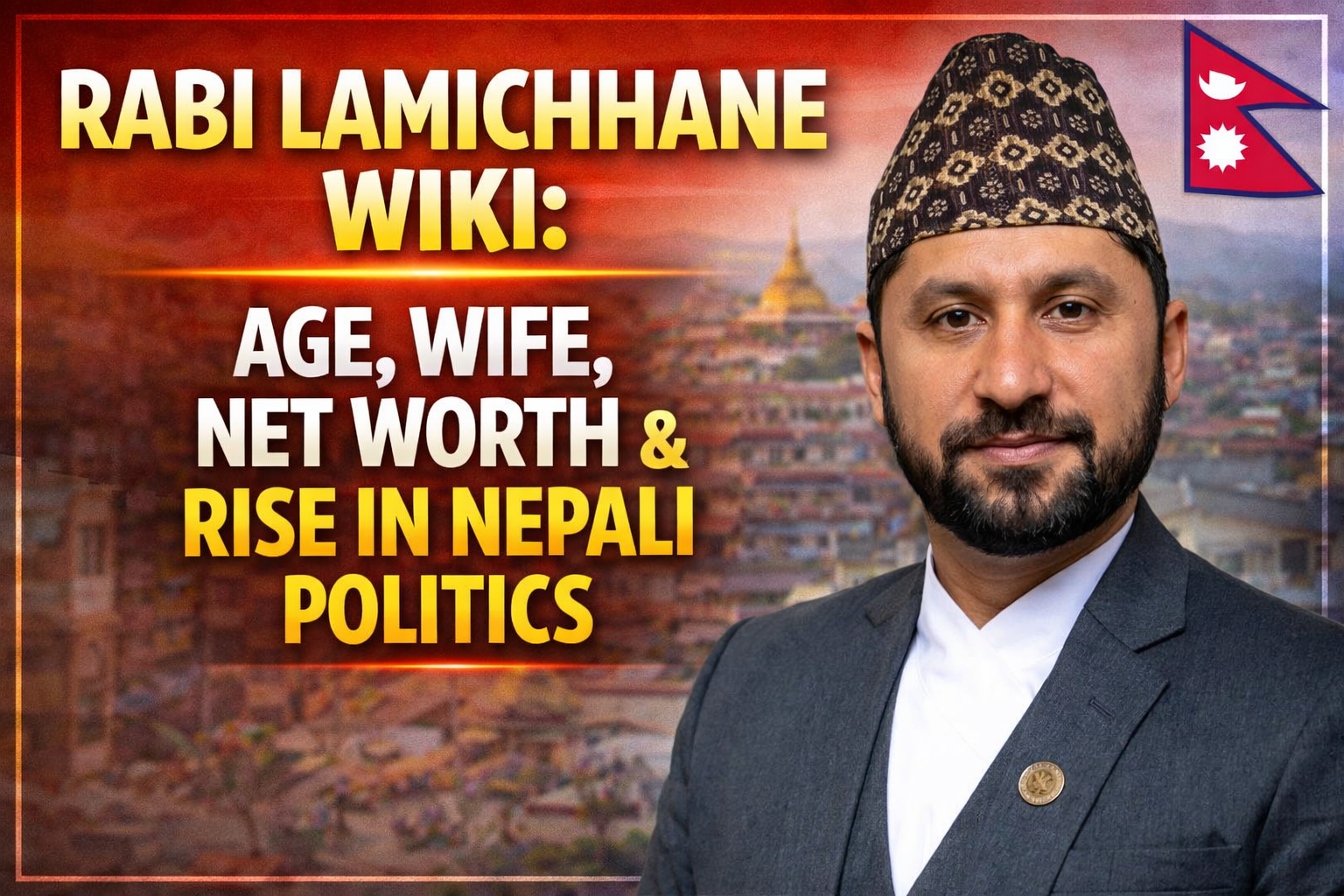
Who Is Rabi Lamichhane?
Rabi Lamichhane (born 13 September 1975) is Nepal’s most consequential and most controversial political figure of the 2020s — a former Guinness World Record-holding television journalist who founded the Rastriya Swatantra Party (RSP) in June 2022, served twice as Deputy Prime Minister and Home Affairs Minister, survived a Supreme Court-ordered citizenship stripping, spent eight months in jail on cooperative fraud charges, walked out of prison during Nepal’s historic Gen Z uprising, and then won his third consecutive parliamentary seat in the March 2026 general election by a margin of nearly 40,000 votes.
At 50 years old, Lamichhane remains the chairman of a party that now holds a near two-thirds majority in Nepal’s House of Representatives — a result widely described as the most decisive electoral mandate in Nepal’s post-monarchy democratic history. His alliance with Balen Shah — the RSP’s Prime Minister-designate and former Kathmandu mayor — has reshaped the entire architecture of Nepalese politics heading into 2026.
His story is one of the most dramatic in contemporary South Asian politics: a decade working at a Subway franchise in Baltimore, Maryland; a Guinness record set by talking continuously for over 62 hours; the founding of a party from scratch that became the country’s dominant political force inside four years; and a legal shadow that has followed him every step of the way, with five cooperative fraud cases still pending as of March 2026.
| Full Name | Rabi Lamichhane (Nepali: रवि लामिछाने) |
| Date of Birth | 13 September 1975 |
| Age | 50 years old (2026) |
| Birthplace | Bhaktapur, Nepal (grew up in Chabahil, Kathmandu) |
| Father | Lal Chandra Lamichhane |
| Brother | Hari Sharan Lamichhane |
| Education | Bhrikuti Secondary School; Ratna Rajya Campus, Kathmandu; Master’s in Journalism & Mass Communication (USA) |
| First Wife | Isha Lamichhane (m. 1995 — divorced 2019; American citizen) |
| Current Wife | Nikita Poudel (m. 21 January 2019; former head, Nepal Film Development Board) |
| Children | Three children |
| Height | 5 ft 7 in (170 cm) |
| Citizenship | Nepali (US citizen 2007–2017; renounced) |
| Political Party | Rastriya Swatantra Party (RSP) — Founder & Chairman |
| Constituency | Chitwan Constituency No. 2 |
| Govt. Roles | Deputy Prime Minister & Home Affairs Minister (twice: 2022–23; 2024–25) |
| 2026 Election | 54,402 votes; margin of 39,838 over nearest rival (Nepali Congress) |
| Net Worth (est.) | NPR 2–5 crore (approx. USD 150,000–380,000) |
| Record | Guinness World Record — Longest TV Talk Show (62 hrs 12 min, April 2013) |
Early Life & Education
Rabi Lamichhane was born on 13 September 1975 in Bhaktapur, the ancient Newari city in Nepal’s Kathmandu Valley, known for its medieval temples, narrow alleys, and fiercely preserved cultural heritage. His father is Lal Chandra Lamichhane, and he has an older brother, Hari Sharan Lamichhane. Though born in Bhaktapur, he grew up in the Chabahil neighbourhood of Kathmandu, where he spent his formative years.
He completed his school-leaving certificate (SLC) from Bhrikuti Secondary School, securing 66.3 percent — moving to Bijay Memorial School for his final SLC year. For higher secondary education, he enrolled at Ratna Rajya Campus in Kathmandu, beginning a course in journalism and mass communication. The media world pulled him in early — he began working as a radio presenter while still a college student, hosting programs on Image FM including “Good Morning Kathmandu” and “Saajha Pakha.”
He moved to the United States in the early 2000s (around 2002 in the Nepali calendar, 2059 BS), where he eventually completed a Master’s degree in Journalism and Mass Communication. The precise institution has not been publicly confirmed in official records, though multiple sources reference his US-based postgraduate studies.
The American Years — Baltimore, Maryland (2002–2017)
Lamichhane spent approximately 12–13 years in the United States, based primarily in Baltimore, Maryland. During this period, he worked as a manager and supervisor at a Subway franchise — a detail that has become one of the most-cited biographical facts about him, often used both by supporters (as evidence of his humble, working-class roots) and critics (to question the gap between his overseas career and his later claims of journalistic authority).
He became an American citizen in 2007, holding dual Nepali and US citizenship — a status that would later become the central legal battleground of his political career. He lived and worked in Baltimore for roughly a decade, traveling to other countries including Japan and the UK, before making the decision to return to Nepal.
In 2017, he renounced his American citizenship and returned to Nepal permanently, claiming that his original Nepali citizenship had been revived upon renouncing the US one. This claim — and whether the proper legal procedures were followed — would later be challenged all the way to Nepal’s Supreme Court.
From managing a Subway branch in Baltimore to founding Nepal’s most powerful political party in four years — Rabi Lamichhane’s trajectory is without parallel in Nepali political history.
— DNA India, March 2026Television Career & the Guinness World Record
After returning from the United States, Lamichhane threw himself back into the Nepali media landscape with remarkable speed. He became the host of “Sidha Kura Janata Sanga” (Straight Talk with the People) on News24 Television — a show that became the defining political interview programme in Nepal’s recent media history. The format was direct, confrontational, and fearless: politicians, bureaucrats, business figures, and celebrities were held to account in real time, with citizen call-ins providing unfiltered public pressure.
His “detective-style” journalism, as it became known, turned him into a household name across Nepal’s hills and Terai regions alike. He interviewed prime ministers, opposition leaders, police chiefs, and celebrities — including a memorable broadcast of “Sidha Kura Pradhanmantri Sanga” (Straight Talk with the Prime Minister) featuring then-PM KP Sharma Oli on Nepal Television and News24.
On 12 April 2013, Lamichhane set the Guinness World Record for the longest television talk show — remaining on air for 62 hours and 12 minutes on News24, interviewing 102 people without significant breaks. The show was themed “Buddha Was Born In Nepal” — a patriotic assertion that drew enormous national attention. The previous record had been held by two Ukrainian presenters at 52 hours. (The record has since been broken by Romanian host Alexandru Raducanu, who surpassed 72 hours.)
He also wrote lyrics for musician Nabin K. Bhattarai’s song “Timilai Man Paraunchhu” and “Timro Aagamanle Feri” by Ram Krishna Dhakal, demonstrating a creative dimension beyond journalism. He resigned from News24 in January 2021 and moved his show to Galaxy 4K TV, where he also served as managing director — a role that would later become the centre of the cooperative fraud allegations against him.
Founding the Rastriya Swatantra Party (2022)
On 16 June 2022, Lamichhane announced his resignation from Galaxy 4K TV and his intention to contest the upcoming general elections. Five days later, on 21 June 2022, he announced the formation of a new political party: the Rastriya Swatantra Party (RSP — National Independent Party), registering his candidacy from Chitwan Constituency No. 2.
The decision was driven by what Lamichhane described as a systemic failure of Nepal’s established parties — the Nepali Congress, CPN-UML, and the Maoist Centre — to deliver on accountability, transparency, or genuine reform. His years of confrontational journalism had given him an unparalleled map of how the Nepali state actually worked, and his conclusion was that the existing parties were structurally incapable of change from within.
The RSP’s debut was stunning. In the November 2022 general election, Lamichhane won Chitwan-2 with a majority of 34,312 votes, defeating Nepali Congress’s Umesh Shrestha (an incumbent minister of state) and CPN-UML’s Krishna Bhakta Pokhrel (the sitting member). Nationally, the RSP won 20 seats, becoming the fourth-largest party in Nepal’s House of Representatives on its first ever outing.
The RSP’s success drew comparisons with other first-time political movements across South Asia — but the speed of the breakthrough, and the scale of the victory margin in Lamichhane’s own seat, were without precedent in Nepal’s post-monarchy democratic era. Compare this trajectory with how other reformist RSP figures have built their careers: Rahbar Ansari, who joined RSP in 2026 and won Bara-4 by 29,561 votes, had spent over a decade in other parties before making the switch.
In its first ever election, the RSP won 20 seats and became the fourth-largest party in Nepal. No political party in post-monarchy Nepal had achieved that kind of debut.
— Wikipedia / Kathmandu Post, 2022Deputy Prime Minister & Home Affairs Minister — Two Terms
Following the 2022 election, the RSP made the strategically controversial decision to back Pushpa Kamal Dahal (Prachanda) for prime minister — a move that drew criticism from supporters who had expected the party to sit in principled opposition. In exchange, Lamichhane was appointed Deputy Prime Minister and Minister of Home Affairs on 26 December 2022.
His first term was short but consequential. Lamichhane emphasised administrative transparency and pledged to modernise Nepal’s internal security apparatus, removing politically-placed police officers and bureaucrats who had overstayed their legal tenure. His confrontational style translated directly from the TV studio to the ministerial office — and the results were mixed, with supporters praising his directness and critics arguing he was governing by instinct rather than institutional patience.
His first term ended abruptly after just 32 days, on 27 January 2023, when the Supreme Court of Nepal ruled that he had not properly reacquired Nepali citizenship after renouncing his American passport — invalidating both his parliamentary seat and his ministerial appointment.
After winning the subsequent by-election with an even larger margin, Lamichhane returned to government as Deputy Prime Minister and Home Minister for a second time, beginning on 6 March 2024. His second term lasted until the House of Representatives was dissolved on 12 September 2025, triggering fresh elections. Across both terms, the RSP alternated between coalition partnerships with Dahal’s Maoists and KP Sharma Oli’s CPN-UML — a pragmatic flexibility that disappointed some supporters but kept the party in a position of influence.
The Citizenship Crisis — Supreme Court Ruling (January 2023)
The most dramatic legal challenge of Lamichhane’s early political career came from an unexpected quarter: not his opponents in Parliament, but the question of whether he was legally a Nepali citizen at all. Nepal’s constitution prohibits dual citizenship — a person holding foreign nationality cannot simultaneously hold Nepali citizenship.
Lamichhane had held American citizenship from 2007 to 2017. When he returned to Nepal, he claimed his original Nepali citizenship was automatically revived upon renouncing his US passport. Critics and political rivals argued that the proper legal procedure — applying for a new Nepali citizenship certificate after renouncing the foreign one — had not been followed.
On 27 January 2023, the Supreme Court of Nepal ruled that Lamichhane had not followed due process to reacquire Nepali citizenship, making him a non-citizen in the eyes of the law. The ruling stripped him of his parliamentary seat, his ministerial positions, and his status as RSP chairman and parliamentary party leader. He immediately tendered his resignation to Prime Minister Dahal.
What followed was an extraordinary political comeback. Lamichhane re-applied for Nepali citizenship through proper channels, re-obtained it swiftly, and then contested the by-election for Chitwan-2 in April 2023 — winning with an even greater margin than his original 2022 victory. The by-election result was read across Nepal as a decisive popular verdict: voters had not punished him for the legal drama; they had rewarded his persistence.
The Supreme Court stripped him of his seat, his ministry, and his citizenship in a single ruling. Within months, he had won them all back — with a bigger margin.
— Kathmandu Post / Wikipedia, 2023The Cooperative Fraud Cases — Five Districts, Billions at Stake
The most serious and sustained legal challenge to Rabi Lamichhane’s career is the set of cooperative fraud allegations spread across five districts. These cases, collectively, represent one of the largest political corruption controversies in Nepal’s recent democratic history — and as of March 2026, all remain ongoing and sub judice. Lamichhane denies all wrongdoing.
The core allegation across the cases is that Lamichhane, during his tenure as Managing Director of Gorkha Media Network Pvt Ltd (operator of Galaxy 4K Television), facilitated or directly enabled the transfer of depositor funds from multiple savings and credit cooperatives into Gorkha Media accounts — funds that were not repaid. A parliamentary investigation committee confirmed that he received over NPR 10 million in salary from Galaxy TV over two years (NPR 7.4 million in 2021/22 and NPR 3 million in 2020/21).
The Five Cases at a Glance
| Case / Cooperative | District | Alleged Loss | Status (Mar 2026) |
|---|---|---|---|
| Supreme Savings & Credit Cooperative | Rupandehi (Butwal) | NPR 109+ million | Core case — ongoing |
| Suryadarshan Cooperative | Kaski (Pokhara) | Not disclosed | Bail granted (NPR 6.5M) |
| Swarnalakshmi Cooperative | Kathmandu | Not disclosed | Bail granted (NPR 6M) |
| Sahara Multipurpose Cooperative | Chitwan (Bharatpur) | NPR 100.8 million | Bail granted (NPR 5.4M) |
| Sano Paila Savings & Credit Cooperative | Parsa (Birgunj) | NPR 115+ million claimed | Charges filed — pending |
The Supreme Cooperative case in Rupandehi is the most serious and most closely followed. Prosecutors allege that over NPR 109 million was transferred from the Butwal-based Supreme Cooperative to Gorkha Media Network, and that Lamichhane — as managing director — was central to that transfer. A further partner, former Deputy Inspector General of Police Chhabilal Joshi, was also charged in connection with the same case.
In the Sano Paila case — the fifth and most recent — the government attorney sought a prison sentence of 6–8 years and claimed NPR 115.69 million in losses, making it the largest individual claim against Lamichhane to date. Investigators alleged he took a NPR 15 million personal loan from the cooperative the day after joining as a member — which was then transferred to Gorkha Media’s account.
On 30 December 2025, Attorney General Sabita Bhandari amended charge sheets in four districts, removing the more serious “organised crime” and “money laundering” charges — leaving only the core cooperative fraud charges in place. This decision was itself challenged by writ petition, and the Supreme Court ordered the Attorney General’s office to provide further documentation to justify the withdrawal.
Arrest, Nine Months in Jail & the Gen Z Jailbreak
In October 2024, Lamichhane was arrested from the RSP party office in Kathmandu in connection with the Suryadarshan Cooperative fraud case. By April 2025, following a Tulsipur High Court ruling overturning a lower court bail order, he was sent to Rupandehi District Prison (Bhairahawa) for trial on remand in the Supreme Cooperative case — placed alone in Block 4 of the facility.
Conditions drew scrutiny: a National Human Rights Commission team found the cell’s windows blocked, reported Lamichhane had been confined to his cell for over 100 days without being allowed to leave — which the NHRC described as a rights violation — and noted the prison toilets were in poor condition. He had a radio but no newspaper access. The Supreme Court of Nepal upheld his detention on 22 May 2025, rejecting bail applications.
The turning point came in September 2025, when Nepal’s Gen Z protest movement — sparked by anger at corruption and government violence — swept through the country. Protesters stormed prisons across Nepal, and Lamichhane was freed from Nakkhu Jail during the chaos. Over 13,000 inmates escaped from prisons across Nepal in what became one of the largest prison breaks in the country’s history. RSP members of parliament joined demonstrators outside the jail.
Lamichhane’s own role in his release was disputed — RSP denied orchestrating a “jailbreak” — but he voluntarily returned to Nakkhu Jail on 13 September 2025, carrying his own belongings, after prison authorities ordered escaped inmates to surrender. The protests ultimately toppled the government of KP Sharma Oli and led to the dissolution of the House of Representatives, setting the stage for fresh elections.
On 18 December 2025, the Butwal bench of the Tulsipur High Court ordered his release on bail of NPR 27.48 million. He was formally released on 19 December 2025, completing the paperwork at Rupandehi District Court — just in time to campaign for the March 2026 general election.
He entered the election campaign directly from bail — nine months in prison, five separate fraud cases pending — and won with 54,402 votes by a margin of nearly 40,000.
— Wikipedia / Kathmandu Post, March 20262026 General Election — Third Consecutive Victory in Chitwan-2
Nepal’s 5 March 2026 general election — held after the Gen Z protest movement forced the dissolution of Parliament and the resignation of PM Oli — was always going to be Lamichhane’s most closely watched electoral test. He contested from Chitwan Constituency No. 2 for the third consecutive time, now under dramatically different circumstances: on bail, with five court cases pending, and heading a party transformed by its alliance with Balen Shah.
The result silenced all doubters. Lamichhane secured 54,402 votes — his nearest rival, Mina Kumari Kharel of the Nepali Congress, received just 14,564 votes. The victory margin of 39,838 votes was larger than either of his two previous wins. It was his third consecutive victory in the same constituency.
Nationally, the RSP secured a near two-thirds majority in the House of Representatives — an historic result that no single party or alliance had achieved in Nepal’s post-monarchy democratic era. The wave swept through Kathmandu and extended deep into the Terai, with RSP winning 30 of 32 Madhesh Province constituencies — a near-total domination of a region that had historically been divided among Madhesi parties, UML, and the Nepali Congress. New RSP voices such as Rahbar Ansari (Bara-4) and Harka Raj Sampang Rai contributed to that sweep.
| Candidate | Party | Votes | Result |
|---|---|---|---|
| Rabi Lamichhane | Rastriya Swatantra Party (RSP) | 54,402 | Winner 🏆 |
| Mina Kumari Kharel | Nepali Congress | 14,564 | 2nd Place |
| Other candidates | Various | — | Defeated |
The Balen Shah Alliance — Architect of Nepal’s New Government
The defining strategic move of Lamichhane’s 2026 campaign was not his own candidacy — it was his decision to bring Balendra “Balen” Shah, the rapper-turned-Mayor of Kathmandu, into the RSP fold and nominate him as prime ministerial candidate.
The two men met in December 2025 — first in a group session, then one-on-one for over six hours — and signed a seven-point agreement on 28 December 2025. Under its terms: if RSP won the election, Balen Shah would become Prime Minister while Lamichhane would remain party chairman. Political analyst Bipin Adhikari called it “a very smart and strategic move” — noting that RSP without Balen had been struggling to maintain nationwide momentum, particularly after the controversies of Lamichhane’s jail term.
Political scientist Gehendra Lal Malla of Tribhuvan University described the arrangement as a “marriage of convenience”: Balen needed a party to contest the election; Lamichhane needed Balen’s mass popularity to reshape RSP’s public image after the cooperative fraud arrests.
The marriage worked. Balen Shah was sworn in as Nepal’s Prime Minister on 27 March 2026 — becoming Nepal’s youngest-ever prime minister and the first of Madheshi origin. Lamichhane, as promised, remained RSP chairman, formally proposing Shah’s appointment as parliamentary party leader at the RSP Central Committee meeting, which endorsed him unanimously.
At an orientation for newly elected RSP lawmakers on 18–19 March 2026, Lamichhane delivered a pointed message: the party’s “right to recall” provision would be enforced. Members were warned to prioritise lawmaking and constituency work over chasing ministerial positions or media appearances — a direct signal that the discipline that defined his journalism would now define his party leadership.
Wife, Family & Personal Life
Rabi Lamichhane has been married twice. His first marriage was to Isha Lamichhane, an American citizen, in 1995. The couple were married for 24 years — though they were reportedly separated for roughly a decade before the formal divorce. Their divorce was finalised in 2019, generating significant media attention in Nepal and among his sizeable fan base. They are reported to have a daughter together.
On 21 January 2019, Lamichhane married Nikita Poudel, a media personality and film producer who at the time served as the chief of the Nepal Film Development Board. Nikita is the daughter of Uddav Poudel, a former party secretary. The couple share an apartment in Kathmandu and are reported to have three children together. Nikita has been a visible presence throughout Lamichhane’s political career, attending public functions and campaign events.
Lamichhane is known for his disciplined personal routine, direct communication style, and a physical presence — at 5 ft 7 in (170 cm) and approximately 73 kg — that projects authority on camera. His social media engagement (@hamrorabi on Instagram) has been a key tool in his political communication, directly addressing supporters without media intermediaries in a manner reminiscent of figures like Rajesh Hamal, Nepal’s greatest film star, who similarly built a career on direct, authentic connection with Nepali audiences across generations.
Rabi Lamichhane Net Worth (2026)
Rabi Lamichhane’s net worth is estimated at NPR 2–5 crore (approximately USD 150,000–380,000), though no official property declaration has been made public. The cooperative fraud cases have brought his finances under unusual scrutiny, with parliamentary committees and court proceedings revealing more detail about his income than is typical for Nepali politicians.
The most reliable figures come from the parliamentary special investigation committee formed to examine cooperative fraud, which confirmed that Lamichhane received NPR 10.4 million in salary from Galaxy Television over two years — NPR 7.4 million in fiscal year 2021/22 and NPR 3 million in 2020/21. His campaign expenditure for the 2026 election was officially declared at NPR 989,000 (approximately USD 7,400) — a modest figure for a high-profile race, submitted in compliance with Nepal’s mandatory campaign finance disclosure laws.
There is no public record of significant real estate or investment holdings. The cooperative fraud cases have, if anything, made it harder to establish an accurate picture — court proceedings have explored his financial relationship with Gorkha Media Network extensively, but no final determination of personal liability has been made. His own position is that the charges are politically motivated and that he has no liability for the fund movements alleged by prosecutors.
1 thought on “Rabi Lamichhane Wiki: Age, Wife, Net Worth & Rise in Nepali Politics”
Comments are closed.