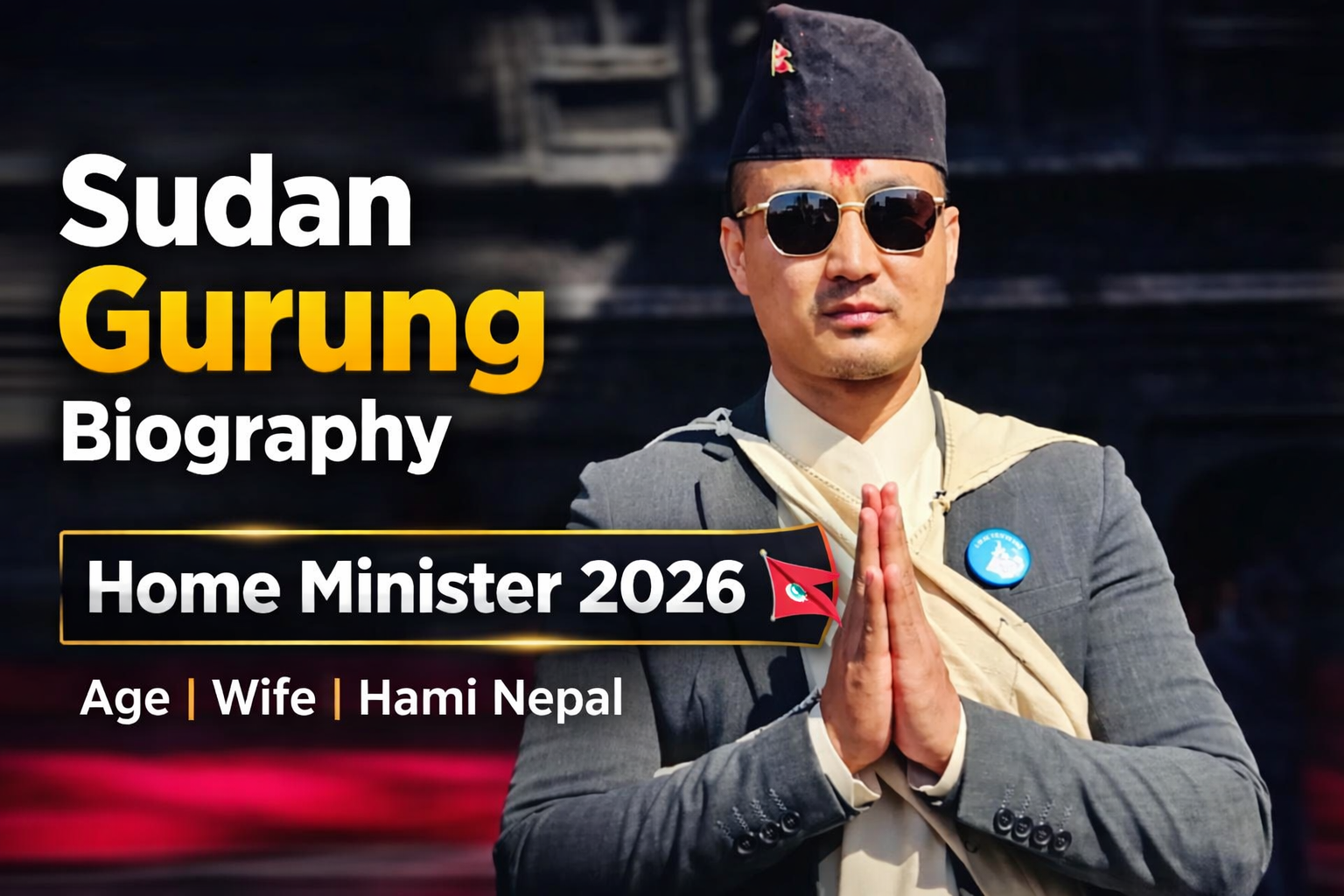
Who Is Sudan Gurung?
Sudan Gurung is a Nepali politician, civic activist, and the founder and president of Hami Nepal — a youth-led NGO that became the organisational engine behind Nepal’s historic 2025 Gen Z protests. Born on September 5, 1987, in Gorkha, Nepal, he is 38 years old as of 2026. He began his adult life as an event manager, DJ, and nightclub owner. A child’s death in his arms during the 2015 Nepal earthquake redirected his life entirely toward humanitarian work. He served as Nepal’s 27th Minister of Home Affairs, appointed on March 27, 2026, in the government led by Prime Minister Balen Shah.
| Full Name | Sudan Gurung |
| Date of Birth | September 5, 1987 |
| Birthplace | Chumnubri, Gorkha District, Nepal |
| Age (2026) | 38 years |
| Wife | Prerana Gurung |
| NGO Founded | Hami Nepal (active 2015; registered 2020) |
| Party | Rastriya Swatantra Party (joined Jan 18, 2026) |
| MP Constituency | Gorkha-1, House of Representatives |
| Votes Won | 29,896 (2026 general election) |
| Current Role | Minister of Home Affairs, Nepal (from Mar 27, 2026) |
| Known For | 2025 Gen Z protests, Hami Nepal, earthquake relief |
Early Life & Family
Born into an ordinary family in Chumnubri, a very remote area of Gorkha, Gurung spent much of his time in Kathmandu. After moving from Chitwan to Kathmandu, he rose to prominence as DJ Sudan after working as a call center employee in Thamel. His early years were not marked by political privilege or connections — he arrived in the capital as an ordinary young man looking for opportunity, the kind of story familiar to millions of Nepalis who migrate from the hills to the city every generation.
Details about his parents and early schooling are not publicly documented. What is clear is that his trajectory — from remote Gorkha to nightclub owner to NGO president to cabinet minister — is one of Nepal’s most dramatic personal stories of the 2020s.
Early Career — DJ, Event Manager & Nightclub Owner
After opening the OMG Club in 2012, he pioneered theme parties, not only earning money from Thamel but also building networks with high-ranking officials. As DJ Sudan, he became a recognisable face in Kathmandu’s nightlife. He worked in event management, learning crowd coordination, logistics, and communication skills that he would later apply in ways nobody — least of all himself — could have predicted.
Reuters described him as a former DJ who later became the founder of Hami Nepal, a group that played an important role in disaster response and protest organising. His entertainment background is not incidental to his later success — it gave him an instinct for reading crowds, creating momentum, and communicating clearly under pressure. Those are the exact skills that made him effective in September 2025.
2015 Earthquake — The Moment That Changed Everything
On April 25, 2015, a 7.8 magnitude earthquake devastated Nepal, killing nearly 9,000 people. During the disaster, he lost his child — a moment that he has cited as a turning point: “A child died in my arms. I’ll never forget that moment.” This personal tragedy — the experience of holding a dying child while the city collapsed around him — cut through the world of clubs and parties and fundamentally altered who Sudan Gurung was.
A child died in my arms. I’ll never forget that moment.
— Sudan Gurung, on the 2015 Nepal earthquake, cited by Reuters, NDTV, LiveMintIn the quake’s aftermath, he used social media to rally nearly 200 volunteers for relief work. This grassroots mobilisation laid the foundation for the creation of Hami Nepal. The ability to coordinate volunteers through Facebook and WhatsApp — which he had honed as an event promoter — became, overnight, one of the most urgently needed skills in the country. He coordinated volunteers, managed the flow of aid, and publicly criticised the government’s corruption as a factor undermining relief efforts. That critique of authority would become a permanent feature of his public voice.
Hami Nepal — Building a Movement
In 2020, he created Hami Nepal, which at the time had over 1,600 members, acting as an alternative emergency response team to the COVID-19 pandemic. Formally registered as an NGO in 2020 under Registration No. 609789065, Hami Nepal operated under the slogan “For the People, By the People” and quickly became a distinctive presence in Nepal’s civic landscape — non-partisan, youth-led, and built on direct community action rather than political positioning.
The organisation has drawn support from high-profile figures: Dr. Sanduk Ruit acts as a mentor, and Miss Universe Nepal 2018 Manita Devkota is its goodwill ambassador. Public personalities like Priyanka Karki, Swastima Khadka, and Abhaya Subba have also contributed to relief and advocacy efforts.
The foundation helped pregnant women and injured individuals during the 2021 Nepal floods and also was one of the foundations to send aid during the aftermath of the 2023 Turkey–Syria earthquakes. For its effort, the NGO received various awards, including the “360 Impact Award” and the “Barbara Foundation Covid-19 Barista Samman Award.”
2025 Gen Z Protests — Toppling a Prime Minister
On September 4, 2025, the government of Prime Minister KP Sharma Oli blocked 26 social media platforms — Facebook, Instagram, WhatsApp, YouTube, and X among them. Sudan Gurung and his organisation, Hami Nepal, called for peaceful protests against the government for banning social media. Ahead of the blackout, Hami Nepal used Instagram and Discord and called people to protest at Maitighar Mandala on September 8. The organisation also shared videos titled “how to protest”, urging students to turn up in uniforms with their books and bags as a peaceful symbol of dissent.
What began as a spontaneous social media protest became a defining moment in Nepal’s political history. The protests toppled Prime Minister KP Sharma Oli and led to hundreds of injuries and at least 30 people killed. Gurung participated in extensive negotiations with the President and the Chief of Army Staff, which led to the finalisation of former Chief Justice Sushila Karki as interim prime minister and the dissolution of parliament, paving the way for early elections.
While widely hailed as a hero of the Gen Z movement, Gurung later faced criticism from within the movement itself. On the night of September 14, 2025, he led protests against interim Prime Minister Karki demanding her resignation — turning against the very leader his negotiations had installed. Critics argued this revealed political opportunism; supporters called it principled accountability.
2026 General Election — MP for Gorkha-1
On January 18, 2026, he joined the Rastriya Swatantra Party, running on their behalf in Gorkha-1 constituency. The decision to join RSP rather than run as an independent was strategic — he stated publicly that a party platform was a more effective vehicle for systemic reform than solo candidacy. Critics questioned whether joining an established (if young) party compromised his outsider credentials. Voters gave their verdict clearly.
Setopati reported that he won the seat with 29,896 votes, defeating his main rivals by a wide margin. He defeated both the Nepali Congress and CPN (Maoist) candidates — traditional vote-bank holders in Gorkha — demonstrating that his support was nationwide, not merely a Kathmandu social media phenomenon.
Home Minister of Nepal — March 2026
On March 27, 2026, Sudan Gurung was appointed Home Minister in the government led by Balendra Shah (Balen Shah). He became Nepal’s 27th Minister of Home Affairs. The appointment placed one of Nepal’s most combative anti-establishment voices in charge of the country’s police, law enforcement, and internal security apparatus — a role that will require the same determination he brought to the streets, now channelled through institutional authority.
Gurung has emphasised that his ideological beliefs include a will for systemic reform, anti-corruption measures, and empowerment of the new generation. As Home Minister, those beliefs will be tested against Nepal’s deeply entrenched bureaucracy, a police force with its own institutional culture, and the expectations of the millions of young Nepalis who marched in 2025 believing that change was possible.
Wife & Personal Life
Sudan Gurung is married to Prerana Gurung. His wife maintains a very private profile and is not publicly active in political or media circles. Gurung himself has kept personal details — his parents, siblings, and family background — largely out of the public domain, a deliberate separation of private life from his intensely public political persona.
His personal tragedy — the loss of his child in the 2015 earthquake — has been publicly referenced in interviews with Reuters, NDTV, and LiveMint, but beyond that defining moment he does not discuss his family publicly. Given that he is now Home Minister, his family’s security and privacy are likely to be even more carefully protected going forward.
Sudan Gurung Net Worth 2026
Based on publicly available information about his income sources and career history, Sudan Gurung’s estimated net worth in 2026 is NPR 1.5–3 crore (approximately USD 112,000–225,000). This estimate is derived from the following verified income streams:
Nightclub & Events Business (2012–2015): As the owner of OMG Club in Thamel — one of Kathmandu’s most commercially active nightlife districts — and as a working DJ and event manager, Gurung would have generated meaningful income across three years. Established Thamel nightclub operations typically generate NPR 10–30 lakh annually in Nepal’s hospitality market.
NGO Leadership (2015–2026): As founder and president of Hami Nepal, Gurung held an unpaid leadership role. Hami Nepal is a registered non-profit and he has not publicly claimed a salary from it. This period represents zero earned income from the organisation itself, though it generated enormous social capital.
Parliamentary Salary (from March 2026): As a Member of Parliament, he earns approximately NPR 60,000–80,000 per month including allowances under Nepal’s parliamentary pay structure. As Home Minister, additional ministerial allowances apply — estimated at NPR 1–1.5 lakh per month in total official compensation.
His publicly declared asset disclosures submitted to the Election Commission of Nepal as a candidate reflect a modest financial profile with no significant real estate or investment holdings reported — consistent with his public image as an anti-establishment reformer. Note: This is an estimated figure based on available data. Sudan Gurung has not publicly disclosed a personal net worth figure.